
Contain:
- chance of suffering a heart attack.
- Acquiring cancer
- Getting addicted to smoking or tobacco
- Taking drugs
- Physical appearance feature elements

We all want the best for our children.
Contain:
J: 政策有什么不好的吗?
J: Is there anything bad about the policy?
M: 国家实行这个政策一家要一个孩子是从整个国家考录的, 但是一个孩子说道好不好,当然不好了。从孩子角度来说,他自己孤单,没有兄弟姐妹。从家庭来说,以后父母老了,孩子结婚了以后,要照顾四个老人。同时两夫妻又要工作,照顾四个老人,那时确实不是什么好事情了。
M: The country implemented the one child per family policy as a preferred option for the country. However speaking for the child, of course it isn’t good. Looking from the child’s perspective, they are going to be lonely with no siblings. Looking from the family’s perspective, when their parents become elderly and the child is married, they will have to help look after four elders. At the same time, the couple will have to work and look after the elders. At that time, in reality it won’t be a desired situation.
J: 那现在他们把政策改了,允许要两个孩子。就是应为这个吗?
J: They have changed the policy now, allowing more than one child. Is that due to the previous reason?
M: 不是应为这个改的。是应为中国现在富强了, 有钱了,意思是鼓励你能多要一个孩子就多要一个吧。但是好多家庭应为现在各方面竞争压力大就还会只要一个孩子。
M: Not solely because of that reason. It is because China is now much more prosperous in terms of growth of country and is encouraging in having more children. At the same time, a lot of families are experiencing a lot of stress, which discourages them to have another child.
J: 那要是说来四十年以后,能有选择克隆人呢?
J: What do you think would happen if in 40 years time, we would have the option of cloning humans?
M: 即便有这样的科学,也不是说谁都能要的。即便克隆能造小孩,这个家庭还是会考虑他自己能不能多养这个小孩,他面临的经济压力大不大。现在在中国培养一个孩子花销相当大了。
M: Regardless of there being this kind of technology, not all people will want it. Regardless of the possibility of cloning a child, the family will still consider whether they are capable of having this child and whether they are capable to handle the financial pressure. Right now in China, it is quite expensive to cater for a child’s needs.
J: 那要是说是只有这个孩子是克隆的呢?
J: What if cloning is used for the one and only child?
M: 你是说就一个孩子,还是克隆的?
M: You’re saying only one child, and he or she is cloned?
J: 是啊。
J: Yes.
M: 为什么呢?人家自己能生,他们为什么要去克隆呢?
M: Why? If a family were capable of having a child naturally, why would they clone one?
J: 那要是不能生呢?
J: What if they are not able to have a child naturally?
M: 如果这对两个夫妻真的不能生小孩的,要是使用克隆技术,也许可以带来一个孩子,这是对来这样家庭的高兴的地方。但是要是正常能生那为什么要是用克隆呢?那没必要嘛。
M: If a couple is not able to fall pregnant with a child, and using cloning as a way to give them a child, then perhaps that would put the family in a positive position. However, if they were capable of falling pregnant with a child, why would they have to clone a child? What is the point?
J: 那要是说不是百分之百克隆呢?比如说有人嫌自己丑,想改变缺点。
J: What if the child is genetically modified? Let’s say some people think they are not blessed in terms of looks and they want to change this for their child?
M: 那才去克隆的方法,是不是还用爸妈的基因?
M: If using genetically modification, would they be using the parent’s genes?
J: 用啊,但是能改变呀。
J: Yes, but they will be making changes to it.
M: 能改变就让他们改变吧。些许到那时候发达了,人的思想也有所转变,他们能喜欢能接受这个。
M: If they are able to change it, then let them change it. Maybe in the future, when people’s perspectives become more widened and open to the thought of genetic modification and liking it.
J: 您觉得这个会带来好的或者坏的方面?
J: Do you think this would have a positive or negative impact?
K: 人会变成不存的。
K: Humans will become artificial.
M: 对呀。
M: Yes.
J: 那您会觉得人都希望是一个某样吗?
J: Would you think humans would all want to look a certain way?
M: 当然是还是爸爸妈妈自己有的孩子是最正常,一代一代人。不同的?要是克隆技术都要那么美美漂亮的想假人的,那还会有什么意思?
M: If a child has their parent’s genes, of course they would be the most original, being passed down from generation to generation. If genetic modification allows all humans to look perfectly sculpted like dolls, how would that be interesting?
K: Why would you want your child to have bad genes?
J: So would you pay for that?
K: Well derrrrrr. Yes, I don’t want some ugly ass kid.
J: 那你会付钱吗?
J: Would you pay for it?
M: 付钱?所以说克隆技术使用不是说人门谁都是能免费用的。使用那个也是会用金钱才能那样的技术。所以有条件的人,他想去做,他才能去做。没条件的人,他们根本不承担呢个费用,他想要也做不成。不管社会这么发展,他还是根据这个人个人条件所决定。
M: Pay money? This is the reason why the use of genetic modification is not something that everyone is able to use. By using it, you would have to pay for it. For those who have the financial stability, if they were willing, they would use it. For those who don’t, they won’t be able to use it even if they wanted to. Regardless of how much society progresses, it is still determined according to the personal capabilities of a person.
__________________
M: 当然对于一个家庭,要两个孩子好过要一个孩子。但是还有一个情况,应为这些年中国政策只让要一个孩子,再加上社会发展这么大,竞争激烈,培养一个孩子费用很高,现在的人有些让他再要一个孩子,他要考录自己的经济条件,就是收入个方面,培养一个孩子有没有条件。现在有些能力上很擦,就这对一个孩子就花销很大的,就不想要第二个孩子。对一比较有条件的,现在要第二个甚至要第三个他要养的起,照样会要的。
M: Of course for a family, having two children is better than having one child. However, under the condition of China’s one child policy and the various pressures within society and the competitiveness, it costs a lot of money to bring up a child. For some, even if they have the option of have another child, they have to consider their own financial state, their income, whether they have the capability to bring up a child. For some who don’t have the capability, they will choose not to have the second child. For some who do, if they want a second child, or even a third, they definitely will.
J: 那要是只能要一个孩子,那个孩子有毛病呢?
J: What happens if they are only able to have one child and that child happens to have special needs?
M: 在中国有这种情况,有一个孩子真正有问题的话,医院出示证明以后,可以向国家要指标要第二胎。第一个孩子有问题,比如像残疾,当然可以会有二胎。国家也不会说是绝对性的,他都是会格局具体情况的。
M: There is this situation occurring in China, if a child has special needs and the hospital gives certified documents, the parents are able to apply to have a second child. If the first child has special needs, for example a disability, of course they will be able to have a second child. The country will not say that it is an absolute; it is still dependent according to various situations.
Our research into Asian aesthetic surgery has led us to speculate our future scenario in China. Growing beauty standards in this region have created a dissolution with self-image and have encouraged young women to try dangerous beauty enhancements to achieve these unrealistic ideals

source: https://www.inkwoodresearch.com/reports/asia-pacific-cosmetic-surgery-procedure-market/

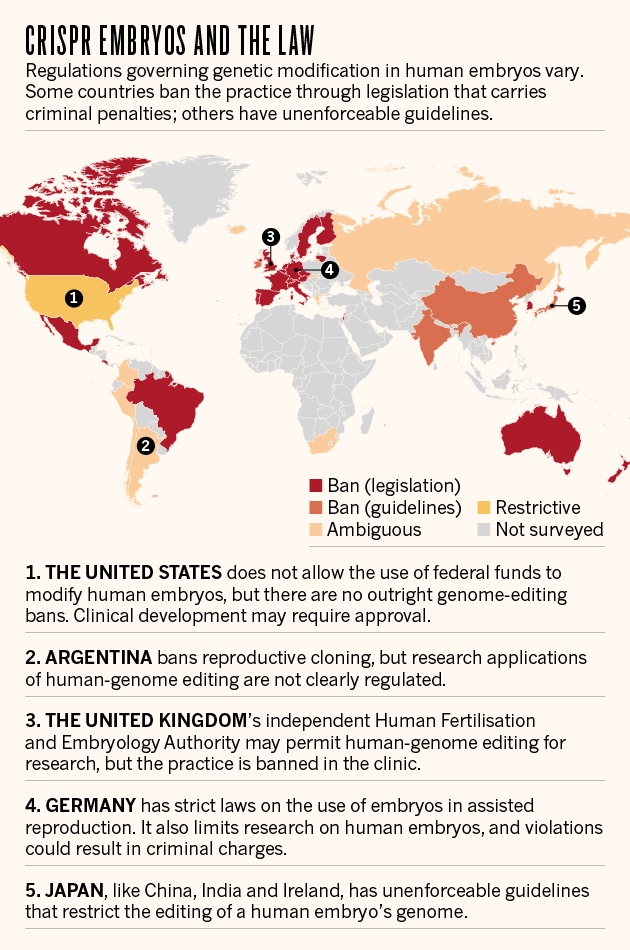
Looking at where CRISPR technology is permitted in 2018 in the world to see where it is most likely that genetic engineering will occur first
Article reference: https://www.nature.com/news/where-in-the-world-could-the-first-crispr-baby-be-born-1.18542
With films such as Gattaca, a story about a naturally born man struggling in a world full of genetically improved people, it is easy to shift Genetic Modification (GM) into the realm of science fiction. However, with new technologies on the rise and as they continue to grow in accessibility, it is fair to conclude that there will be an exponential increase in the development of this field. According to the National Academy of Sciences, Engineering and Medicine, many preconceptions we hold about GM are not as fictional as they seem.
Above is the trailer of Gattaca.
According to the National Academy, “Human genome editing is already widely used in basic research and is in the early stages of development and trials for clinical applications that involve non-heritable (somatic) cells.” They also claim that many of these will eventually be able to cure certain genetic diseases. With hereditary GM, scientists may be able to affect not only the subject, but also their future offspring. An example of an effect of hereditary GM is the change in mosquitos and ultimately achieving their immunity to diseases such as malaria and dengue fever virus, which would eventually stop humans from contracting the disease (Leopoldina, 2015).
The National Academy does concede however, that many have argued for the ethical and moral case behind opposing genetic modification. Some believe that an alteration should not be used “for any purpose other than treating or preventing disease or disability.” As conscientious individuals, such a position seems ethical and appropriate for a field of science that has not been fully developed. However, our group’s scenario is to explore the situation in which science has delved past such boundaries.
As our group continues to understand the nature of and the context around GM, it is important to integrate our understanding of ethical issues that are related to this. As such, certain questions must be asked:
In developing this positioning, it is evident that there are a multitude of ethical and relational issues existent in the the possible perfection of genetic modification and birth. In my 1c. Interview Article, I outline with my interviewee the concept of our scenario and we discuss the potential marring of a mother and child relationship. How can a baby be cared for if it has not acclimated to the smell, touch and sound of its mother? These are potential detriments that we would explore in our scenario and the impact of a world focused on the perfection of human development and beauty. Such a world would lead to an unfortunate change in the landscape of child development.
References:
Gattaca, 1997, motion picture, Columbia Pictures and Jersey Films
Leopoldina, 2015, “Experts call for the responsible use of new genome editing techniques” <https://www.sciencedaily.com/releases/2015/09/150929070412.htm?utm_medium=cpc&utm_campaign=ScienceDaily_TMD_1&utm_source=TMD>, viewed 30 Aug 2018
National Academies of Sciences, Engineering, and Medicine, 2017, “With stringent oversight, heritable human genome editing could be allowed“, <https://www.sciencedaily.com/releases/2017/02/170214130539.htm?utm_medium=cpc&utm_campaign=ScienceDaily_TMD_1&utm_source=TMD>, viewed 30 Aug 2018


 Beautiful is Better